
Training in the language each person reads, and a record of the language they passed in
Films and written lessons in 64 languages, each rebuilt from your document rather than dubbed. Learner screens in 18 languages and practice calls in 19. Every certificate names the language it was taken in.
One site, many languages, one standard
-
The procedure is in English
Many of the people who follow it read Hindi, Tamil, Kannada, Odia or Arabic far better.
-
Translation can change the meaning
A translated test can shift an answer, and a figure can change on its way into another language.
-
The auditor asks about language
Was the training given in a language the worker understands, and can you show which one?
One document, every language, the same standard
-
Send one document
In the language it was written in. Languages come from each person’s record, or exactly the ones you choose.
-
Rebuilt in every language, then checked
Lessons, questions and narration are made in each language. Every one is checked for words in the wrong language or script, and must carry the same figures as the original. Your team approves the questions.
-
A certificate that names the language
Each person is tested in their language and marked to the same answer key, and the certificate says which language it was.
The numbers, exactly
-
64 languages for films and lessons
Including Hindi, Kannada, Tamil, Telugu, Malayalam, Marathi, Bengali, Gujarati, Punjabi, Odia, Assamese, Urdu, Arabic, Filipino, Nepali and Sinhala.
-
18 learner-screen languages
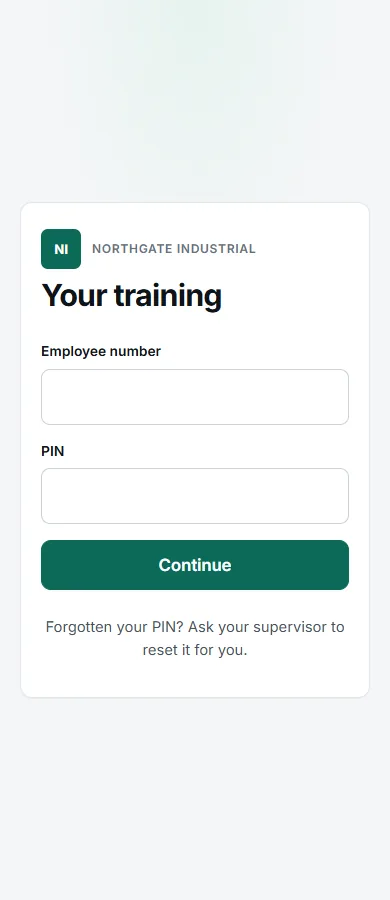
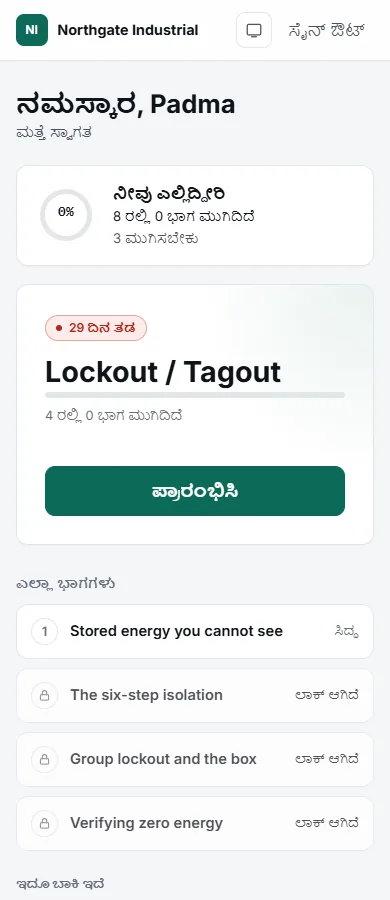
Buttons, progress and results: English, Arabic, Hindi, Urdu, Malayalam, Filipino, Bengali, Nepali, Sinhala, Tamil, Telugu, Kannada, Marathi, Odia, Spanish, French, Portuguese and Indonesian.
-
19 practice-call languages
Voice practice calls in all eighteen learner-screen languages, plus Gujarati. Practice only: certificates come from the test.
-
Right to left where needed
Arabic and Urdu films and screens read right to left, and names in English letters keep their order.
-
The answer key never moves
A translation cannot change the right answer, so a person tested in Bengali is marked to the same standard as one tested in English.
-
Your choice is final
If you choose the languages for a course, that set is never widened or narrowed for you.
What buyers ask us
Is the training dubbed or subtitled?
Neither. Each language is rebuilt from your document: the lesson, the questions and the narration.
Which languages are the learner screens in?
Eighteen: English, Arabic, Hindi, Urdu, Malayalam, Filipino, Bengali, Nepali, Sinhala, Tamil, Telugu, Kannada, Marathi, Odia, Spanish, French, Portuguese and Indonesian.
What if someone’s language is not one of the eighteen?
Their lessons and films can still be in it, among the 64. The buttons and menus around them are shown in one of the eighteen.
How are translations checked?
Every lesson and question is checked for words in the wrong language or script, and every translation must carry the same figures as the original. Answer keys never change between languages.
Can people practise speaking in their own language?
Yes, with Live Practice: voice practice calls in 19 languages. Practice only; certificates still come from the test.
Prices are quoted for each company: ask for a quote. How every step works is in the product guide.
See it on one of your own documents
Examiverse turns your document into lessons, tests, certificates and reports on its own. Tell us how many people and which languages, and we send a written quotation.